A particularly active sun will make for spectacular viewing and science opportunities.
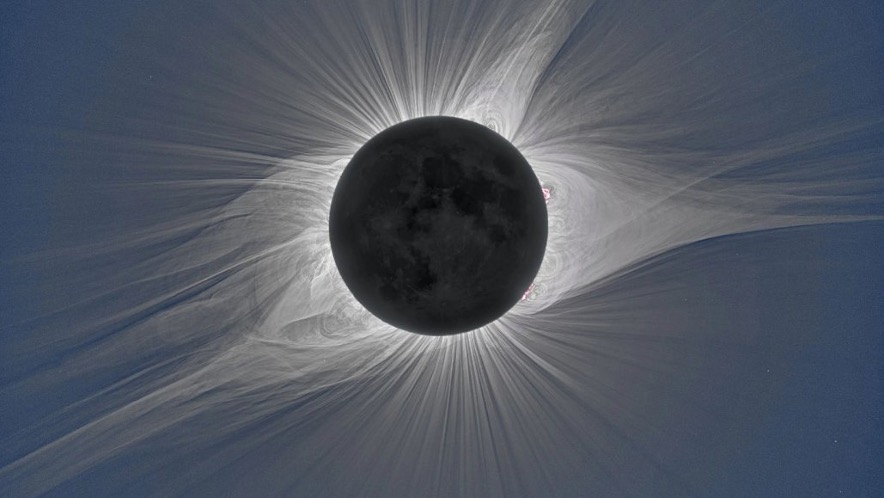
The sun’s corona on full display during the August 21, 2017, solar eclipse.
Solar eclipses are dramatic events as a rule. But the total eclipse coming on April 8 is going to ratchet up the experience. Compared with the last total eclipse that crossed North America, this year’s total eclipse will last longer, the sky will fall darker, and the sun itself will put on a much livelier show. And millions more people will be able to step outside their front doors to see one of the most astounding astronomical events of their lives.
It will also be the last major eclipse to cross North America for 20 years. All of that means that it’s an especially rare opportunity for casual observers and scientists alike. Here are a few things to know about this spectacular event.
Why will this eclipse last longer and feature a more active sun?
The moon will be at a point in its orbit that is comparatively close to Earth in April, making the moon appear particularly large. As a result, it will be an especially dark eclipse that will last for nearly 4½ minutes.
What is more, the sun will be close to solar maximum in 2024. That is the peak of its roughly 11-year activity cycle. As a result, lots of bright, petal-like streamers of plasma will extend from the solar corona, the sun’s outer atmosphere. The increase in solar activity also ups the chances of a coronal mass ejection, a large puff of hot gas trapped in a loop of magnetic field that’s blasted away from the sun’s surface.
A longer time to observe the eclipse and a more active sun will make it both a better show and a boon for scientists who have more telescopes, sensors, and satellites available to study the sun than ever before. Even viewers without other equipment should be able to see the streamers and a coronal mass ejection if it occurs.
What is different about this eclipse’s path?
There is nearly 32 million people inside the path of totality. The eclipse will be visible to some degree in every U.S. state as well as portions of northwestern Mexico and southeastern Canada. The eclipse on April 8, 2024, will enter North America in western Mexico around 12:10 p.m. Mountain Time, cross the United States, and exit through southeastern Canada around 5:15 p.m. Newfoundland Time.GreatAmericanEclipse.com
What is unique about this chance to spot a coronal mass ejection?
Because of the sun’s elevated activity this time, the chances are unusually high that terrestrial eclipse observers and space satellites could have the opportunity to simultaneously study a coronal mass ejection.
That means that ground-based observers would be able to watch a coronal mass ejection traveling out from the sun, while the satellites would see the event head on, if they happen to lie in the path on an ejection and could take samples as the solar material goes blasting past. It is the only time in the lifetimes of the two satellites that the arrangement will coincide with an eclipse at solar maximum.
Scientists want to know more about coronal mass ejections because the solar eruptions, when aimed at Earth, can disrupt communications, and power grids, and potentially threaten satellites or astronauts in orbit around Earth.
In addition to observing any ejection, the satellites’ observations could help confirm the source of particularly speedy solar winds, which seem to be accelerated by kinks that develop in magnetic fields near the surface of the sun.
Insights into the solar wind, in turn, help explain how coronal mass ejections can affect Earth. That is because the ejections pile up material in the solar wind, which will affect the arrival time of these events to earth. So, knowing the conditions of the solar wind before the ejections is extremely important to predict when they are arriving or how important they will be.”
An astronomical event to remember.
Once this year’s eclipse wraps up, that will be it for North America for a while. In 2033, Alaska will get an exclusive show in the western part of the state, which might partly make up for it having the worst seat in the house, as far as U.S. states go, this time around. Only a sliver of the state will be within range to see a portion of the sun covered up. After that, there will be an eclipse primarily over Canada in 2044, and another that will cross the United States and eastern South America in 2045.
While the astronomical event on April 8 will be both livelier and longer than many eclipses, it does not diminish the importance of studying other eclipses. Every total solar eclipse yields new discoveries.
If you are one of the lucky tens of millions of people who will have a chance to enjoy totality in person, or among of the hundreds of millions within range of the partial eclipse, this is an astronomical event you will not want to miss.
Michel Ouellette JMD, ll.l., ll.m.
JMD Live Online Subscription link

J. Michael Dennis, ll.l., ll.m.
Business & Corporate Strategist
Systemic Strategic Planning
Quality Assurance, Occupational Health & Safety, Environmental Protection, Regulatory Compliance, Crisis & Reputation Management
Skype: jmdlive
Email: jmdlive@jmichaeldennis.live
Web: https://www.jmichaeldennis.live
Phone: 24/7 Emergency Access
Available to our clients/business partners
 J. Michael Dennis ll.l., ll.m. Live
Leave a comment