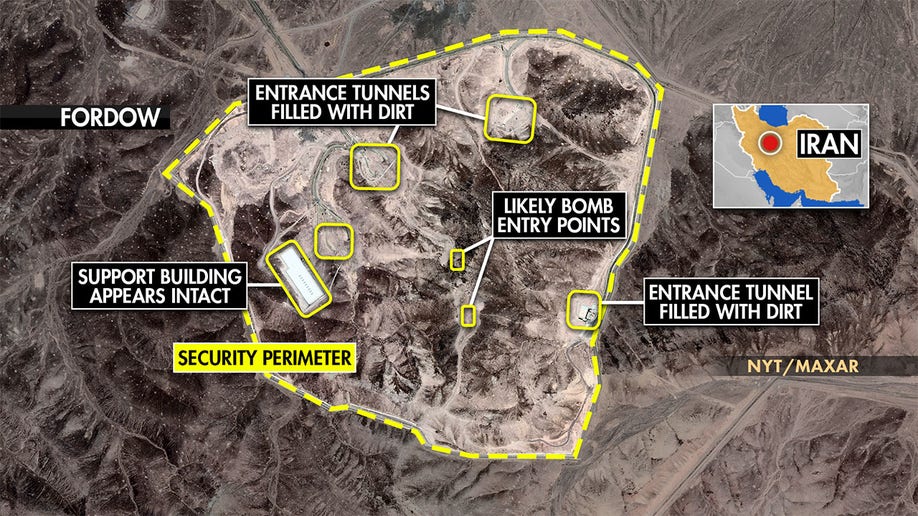
Reality Check: Fordow was not obliterated.
On June 21 2025, as part of the “Operation Midnight Hammer”, using advanced bunker-buster bombs, the U.S. Military conducted a significant strike on the Iran’s Fordow nuclear facility. Contrary to what dictator Trump and his puppets want you to believe, Fordow was not “OBLITERATED”. Here is what delusional Trump and his kissing ass puppets are not telling you.
Let me start by recalling what I know about Fordow.
Fordow is an Iranian uranium enrichment site buried deep 80-90 meters deep under a mountain, with layers of rock and reinforced concrete. That is a tough target. Bunker busters like the GBU-57 MOP are designed for deep penetration, but Fordow’s depth is a challenge. The MOP can go up to 60 meters, but Fordow is deeper. So one bomb might not reach the critical areas. The user might be wondering if a single strike could do it, but multiple hits would be necessary.
Then, there’s the facility’s structure.
It is not just depth; the mountain itself acts as a natural barrier. Rock layers can deflect blasts or absorb shock. Plus, internal hardening with concrete and blast doors adds more protection. Even if a bomb penetrates, the damage might be contained to one section; facilities like Fordow are highly compartmentalized.
What about the weapons?
The MOP is the largest, but its effectiveness is limited against such depths. The GBU-72 is newer but still untested against targets like Fordow. Then there is the idea of nuclear bunker busters, but that’s a whole different level with massive fallout.
Timing and accuracy matter too. Hitting the same spot repeatedly requires precision. Fordow’s location in a mountainous area complicates strike paths. Air defenses and potential Iranian retaliation are also factors. Geopolitical risks are to be considered.
Collateral damage is another concern. The facility is near populated areas, and using multiple bombs or nukes would cause civilian casualties and radiation hazards. The environmental and humanitarian impact are to be considered.
So, summarizing:
the complete “OBLITERATION” of Fordow is technically possible with multiple MOPs or newer weapons, but extremely difficult. Full destruction is unlikely without nuclear options. The Fordow Fuel Enrichment Plant (FFEP) is one of the world’s most heavily fortified nuclear facilities, making its complete destruction by conventional “bunker buster” bombs extremely difficult, likely requiring a massive, multi-weapon strike with limited certainty of success.
Key Challenges in Destroying Fordow
- Extreme Depth & Hardening:
- Buried under ~80-90 meters (260-300 feet) of solid rock/mountain.
- Reinforced with thick concrete linings, steel liners, and blast doors.
- The mountain itself acts as a massive shock absorber and deflector.
- Compartmentalization:
- The facility is divided into multiple halls and tunnels. Destroying one section may not affect others significantly.
- Precision & Accuracy:
- Requires hitting a small, deep target with pinpoint accuracy, repeatedly, on the same spot. GPS jamming, terrain, and air defenses complicate this.
- Weapon Limitations:
- GBU-57 MOP (Massive Ordnance Penetrator): The largest conventional bunker buster.
- Depth: Can penetrate up to 60 meters (200 feet) of reinforced concrete or ~8 meters (25 feet) of ultra-high-strength concrete (like Fordow’s) before detonating. This likely places the explosion above the most critical centrifuge halls.
- Power: ~2.4 tons of high explosive. Significant, but potentially insufficient against such deep, compartmentalized targets.
- GBU-72 (Advanced 5K Penetrator): Newer, carries ~5,000 lbs of explosive. More powerful than MOP per unit, but likely has less penetration depth. Effectiveness against Fordow is untested.
- Multiple Hits Needed: Destroying Fordow would likely require dozens of MOPs or GBU-72s hitting precisely the same point(s) to “drill” down to the cavern level and then cause catastrophic collapse/destruction inside. Success is not guaranteed.
- Nuclear Bunker Busters (Theoretical & Highly Unlikely):
- Low-yield nuclear earth-penetrating weapons (e.g., B61 Mod 11) could potentially destroy Fordow by creating a massive underground cavity/collapse.
- However: Using nuclear weapons would be a catastrophic escalation with severe global political, environmental, and humanitarian consequences. It is highly improbable outside of a full-scale nuclear conflict.
What It Would Take (Conventionally)
- Massive Strike Package:
- Dozens of Aircraft: Heavy bombers (B-2 Spirit, possibly B-52 or B-1B modified) carrying multiple MOPs/GBU-72s each.
- Escorts & SEAD: Extensive fighter escorts and Suppression of Enemy Air Defenses (SEAD) to counter Iran’s robust air defense network protecting Fordow.
- Multiple Waves: Likely requiring sequential strikes over hours or days.
- Pinpoint Accuracy & Multiple Hits on Target:
- Weapons must hit within meters of each other repeatedly to progressively break through the mountain and facility structure.
- Requires unimpeded GPS/INS guidance and potentially terminal laser guidance (difficult against a buried target).
- Weapon Effectiveness:
- Using the most advanced penetrators (MOP, GBU-72).
- Weapons must function perfectly upon impact at hypersonic speeds.
- Achieving “Functional Destruction”:
- Goal 1: Cause massive rockfall/collapse, burying and crushing the centrifuge halls and critical infrastructure.
- Goal 2: Destroy power supplies, ventilation, and control systems essential for operation.
- Goal 3: Render the tunnels impassable and the site irrecoverable without years of reconstruction.
Likelihood of Full Destruction
- Low with Conventional Weapons: While a massive conventional strike could severely damage, disable, and bury parts of Fordow, guaranteeing the complete physical annihilation of every critical component deep within the mountain is highly uncertain. Some hardened sections might survive.
- High with Nuclear Weapons: Technically possible, but politically and strategically catastrophic.
Additional Considerations
- Collateral Damage: Significant civilian casualties and environmental contamination (from conventional explosives, potential release of nuclear materials, or massive dust/debris) are highly likely.
- Iranian Retaliation: Such an attack would almost certainly trigger a major regional war.
- Intelligence: Success depends on flawless, real-time intelligence about exact layouts and vulnerabilities, which may be incomplete.
Conclusion
While a massive, sustained attack using the most advanced conventional bunker busters (dozens of GBU-57 MOPs or GBU-72s) could severely cripple and likely functionally destroy the Fordow facility for a long period, achieving guaranteed, complete physical annihilation of every component deep within the mountain using conventional weapons alone is unlikely and highly uncertain.
Complete destruction with high confidence would almost certainly require the use of nuclear earth-penetrating weapons, an option fraught with unacceptable consequences. Fordow’s design represents the pinnacle of nuclear facility hardening, making it an extraordinarily difficult target to eliminate completely with existing conventional military means.
Michel Ouellette JMD, ll.l., ll.m.
Continuity Strategist

JMD SYSTEMICS, a division of King Global Earth and Environmental Sciences Corporation
Systemic Strategic Planning / Crisis & Reputation Management
X: jmdlive
Email: jmdlive@live.ca
Web: https://jmichaeldennis.live
Michel Ouellette / J. Michael Dennis, is a Former Attorney, a Trial Scientist, a Crisis & Reputation Management Expert, a Public Affairs & Corporate Communications Specialist, a Warrior for Common Sense and Free Speech.
 J. Michael Dennis ll.l., ll.m. Live
Leave a comment